Overview
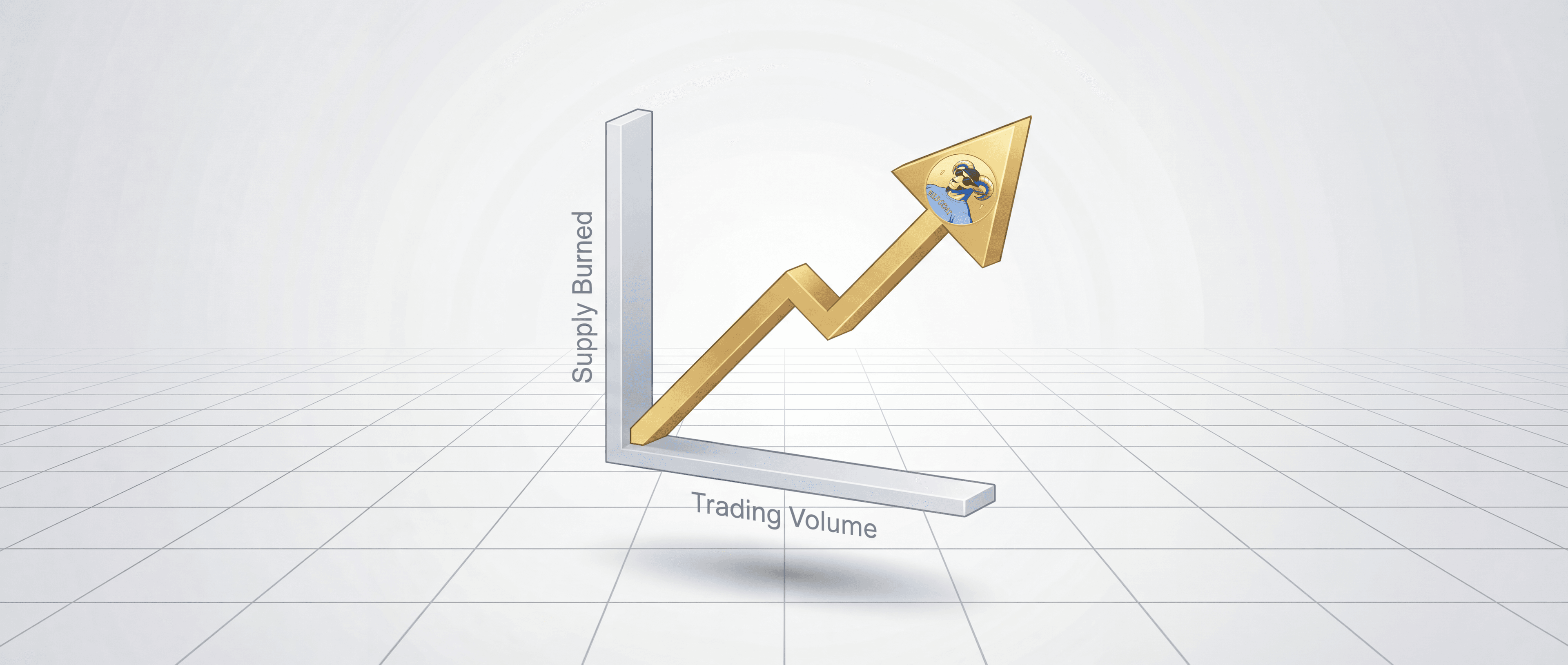
Wild Goat Coin is designed to become more scarce over time. Trading fees from permanently locked liquidity pools are used to buy back and burn WGC, creating deflationary pressure and reducing total supply.
| Trading Pair | DEX Protocol | Chain | Swap Fee | Pool Address |
|---|---|---|---|---|
| WGC / flETH | Uniswap V4 / Flaunch | Base | 1.00% | 0x09f…6176 |
| WGC / WHYPE | Hyperswap V3 | HyperEVM | 1.00% | 0xc53…004f |
| WGC / WETH | Uniswap V3 | zkSync Era | 0.01% | 0x75a…ac5a |
Base
On Base, WGC is integrated with Flaunch Protocol and utilizes the WGC/flETH liquidity pool.
The pool applies a 1% swap fee, collected in ETH via the flETH representation. All fees are deployed into a Progressive Bid Wall — an automated market-making mechanism that provides dynamic price support and facilitates buybacks during market pullbacks.
How It Works
Swap fees accumulate until they reach a 0.1 ETH threshold. Once triggered, the protocol deploys collected ETH as a concentrated liquidity position placed one tick below the current market price.
The Bid Wall Cycle:
- Accumulate → Swap fees accrue until the 0.1 ETH threshold is reached
- Deploy → ETH is placed as buy-side liquidity just below current price, combined with any existing ETH from the previous position
- Support → If price drops into range, the bid wall automatically buys WGC with its ETH
- Reposition → When the next 0.1 ETH threshold is reached, the position rebalances to one tick below current price – any WGC held at this point is transferred to the burn address, and all ETH (from previous bid wall + new fees) forms the new bid wall
As price moves, each reposition maintains support just below spot while potentially increasing bid wall size as new fees accumulate.
Note: WGC is only transferred to the burn address during a reposition if the wall is holding WGC at that moment. If price rises and the wall’s WGC is bought before the next reposition, no tokens are burned in that cycle — the ETH received simply rolls into the next bid wall.
The mechanism functions as a self-sustaining market maker – accumulating fees, providing buy-side liquidity during pullbacks, and burning acquired WGC at reposition.
Checking Bid Wall Status
Current bid wall status can be queried on Basescan via the AnyBidWall contract using pool key:
0x09f89a96f11303d9afbef9e3f2c218b097a4efd0a1f007747948afb095236176| Function | What It Shows |
|---|---|
poolInfo | Pending ETH fees, cumulative fees collected, current tick range |
position | ETH and WGC amounts currently held in the bid wall position, pending ETH fees |
Burned Tokens
During repositions, any WGC held by the bid wall is transferred to 0x3c5...5792 – a permanently inaccessible treasury contract. Its ownership NFT has been transferred to burn address 0x000...dEaD, resulting in WGC transferred there being permanently removed from circulation.
HyperEVM
On HyperEVM, WGC maintains a WGC/WHYPE liquidity pool with a 1% swap fee. Core LP positions for this pool are permanently locked via HyperSwap’s Burn & Earn vault.
Swap fees generated by the core LP positions accrue in WHYPE and WGC to 63 delegate NFTs, all owned by Wild Goat Coin’s Collect, Buy & Burn contract.
How It Works
The collect, buy and burn process is implemented through two fully permissionless functions, callable by any network participant:
claimFees:
Collects accrued WHYPE and WGC into the contract from all delegated positions.
swapAndBurn:
If more than 0.1 WHYPE has been collected, executes a transaction that:
- Uses all accumulated WHYPE to buy WGC from the pool
- Immediately sends accrued and newly acquired WGC to the burn address
0x000...dEaD– permanently removing it from circulation
Swaps are protected by a time-weighted average price (TWAP) oracle, which constrains execution to a price range derived from recent on-chain observations.
Technical Note
HyperEVM uses a dual block architecture, consisting of:
- Small blocks for standard, fast transactions
- Big blocks for transactions with higher gas requirements
claimFees aggregates rewards from all LP positions in a single call, and therefore requires approx. 5M gas, exceeding the small block limit. Callers should enable big block mode on their wallet prior to execution.
Big block mode can be toggled using this official tool.
The swapAndBurn function operates within standard small block limits and does not require any special configuration.
To use big block mode, your wallet must first be activated on Hyperliquid Hypercore. Connect to the Hyperliquid App and deposit at least 1 USDC (this can be withdrawn afterwards).
zkSync Era
On zkSync Era, WGC maintains a WGC/WETH liquidity pool configured with a 0.01% swap fee.
This pool is deployed with permanently locked liquidity and no mechanism to collect accrued fees. As a result, trading activity in this pool effectively removes both WGC and ETH from circulation over time.
Rather than routing fees through an active buyback process, this design implements a passive deflationary effect, where value is continuously locked at the protocol level without requiring additional contracts or intervention.
Design Philosophy
Across all environments, WGC’s buyback and burn approach is guided by a consistent set of principles:
- Fees are derived directly from WGC trading activity
- Liquidity is treated as permanent infrastructure
- No reliance on centralized treasuries or discretionary control
Different chains employ different implementations, but all are designed to align market activity with long-term supply discipline.